
Second Session of Carbon Pricing Education – Affordability and Distributional Impacts
The second installment of the six-part “Carbon Pricing Education” series took place on Oct. 1. It covered the “Affordability and Distributional Impacts” of various carbon pricing policies. Links to the recording, slides, transcript and outline/summary are attached at the very bottom of this post.
In the talk, Marc Hafsted, PhD, shared the latest economic analyses of different carbon pricing policies – basically updating our understanding of the “Household Impacts Study” that CCL used during the effort to pass the Energy Innovation and Carbon Dividend Act of 2019.
Why Now?
 Carbon pricing is not just another policy proposal CCL supports. It has long been the central, sometimes the singular, focus of our advocacy. In the early 2010s, it was CCL’s first major proposal. During the 2010s, support built and peaked in 2019 with the Energy Innovation and Carbon Dividend Act of 2019 (EICDA), which garnered 86 co-sponsors, including 1 Republican, Francis Rooney (R-FL-19), who retired at the end of that session. Carbon Pricing had a moment in 2022, when the Democratic Congress passed its partisan reconciliation Bill, the IRA, with zero Republican support, and Senate Democrats could get only 49 senators to support carbon pricing. Since then, with Congress divided in the 2023-4 (118th) Congress and under solely Republican control in the current 119th Congress, carbon pricing is viewed as politically unviable, some would say impossible.
CCL leadership is responding to that challenge by using the next 6 months to drop back from the front lines of advocacy and do a deep dive into the current economic and political realities that inform our work. It’s not 2019, and to be effective, we need to understand the current research on the economics, politics, and realities of the information environment in which our work occurs.
What Is CCL Doing?
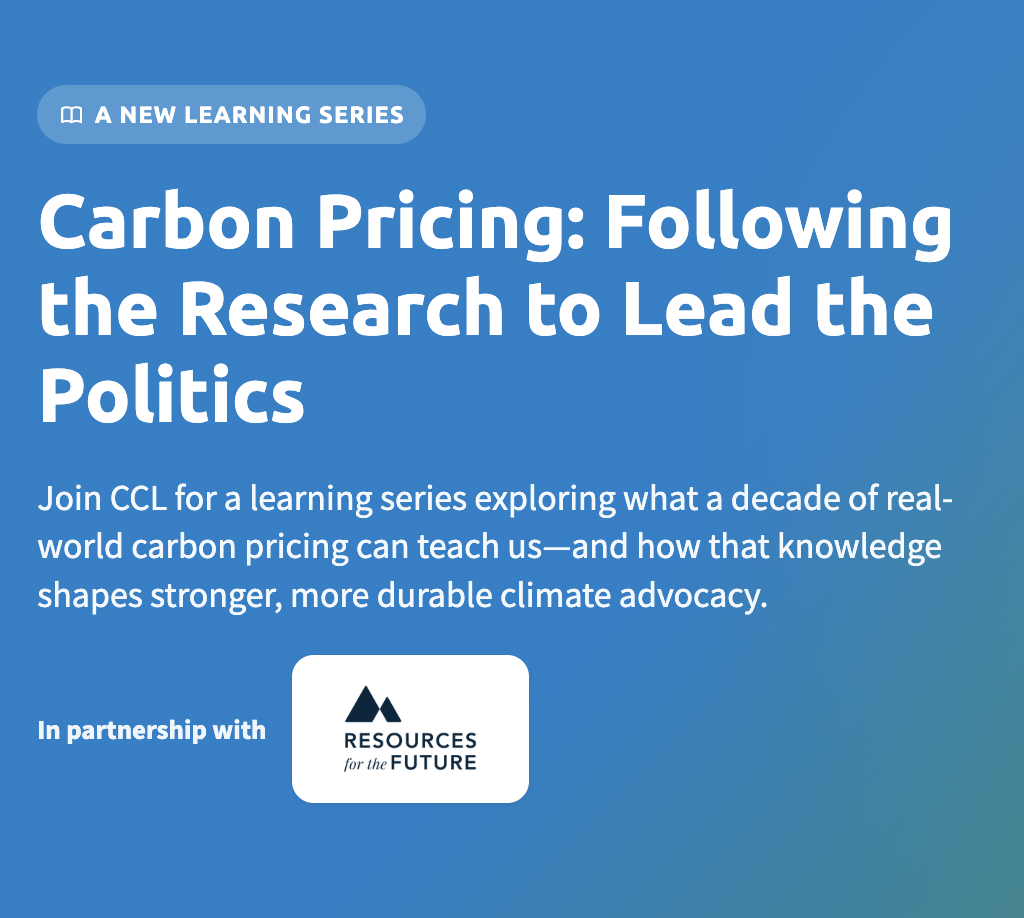
CCL is offering a 6-part educational series to get us ready for a new push in the next Congress, armed with the latest evidence-based understanding of the political, economic and communications science. Stated is not 2019 anymore. To advocate effectively for this powerful policy, we need to understand how to influence and persuade opinion leaders and legislators NOW. So, six deep-dive educational sessions have been scheduled, with the first one on Sept. 3rd.
 For this push, CCL is partnering with a well-regarded, nonpartisan Washington think tank called Resources for the Future. It has a Carbon Pricing Initiative led by Dr. Marc Halstad, a Stanford PhD with 15 years of policy research. His work focuses on the evaluation and design of climate policy, with a specific emphasis on Carbon Pricing Design (analyzing different policy options, including carbon taxes and cap-and-trade systems, and their potential outcomes); Economic Modeling (how carbon affects GDP, employment, etc.); Affordability and Equity (how carbon prices affect different groups); Regional and State Policy (evaluating current, state-level carbon pricing schemes) and Policy Analysis Tools (developing resources like the Carbon Pricing Calculator and Carbon Pricing Bill Tracker).
Sign Up For the Series: Register here
Learn More
Here is the outline of what the sessions will cover
- Sept. 3: Current economic consensus on carbon pricing (“Carbon Pricing 101”)
This session covers the basics of carbon pricing for those new to the topic. You’ll hear from researchers who’ve made substantial contributions to the field in the academic literature. - Oct. 1: Affordability and distributional impacts
A central consideration for policymakers today is affordability. This session will explore how to approach these chief concerns with carbon pricing designs. - November 5: Current policy trends: CBAMs, intensity, and sectors
Though it can sometimes seem like little is happening on carbon pricing, globally the opposite is true. Carbon pricing policy is booming around the world and this session will explore the designs. - Jan. 7: Intensity standards as market-based mechanisms
While the US is the only developed economy without a nation-wide carbon price, it was the first country to impose a methane fee. Though repealed since then, its design holds insights into how US lawmakers can structure future climate policy. - Feb. 4: US State and Local Developments
While carbon pricing policy has stalled at the federal level, recent developments at the state/local level will be explored, as they often serve as laboratories by enacting policies that are later copied at the federal level. - Mar. 4: A Global Look
Several large emerging economies have passed laws and are developing carbon pricing programs. This session will explore these countries that will have a significant impact on total global emissions.
Materials from the Sessions
We will post links to the materials presented so late arrivals can catch up and access the thoughtful materials RFF and CCL prepared and presented.
Sept. 3, 2026 – Carbon Pricing 101
- Recording – Carbon Pricing 101
- Slides – Carbon Pricing 101
- Transcript – Carbon Pricing 101
- Outline & Summary – Carbon Pricing 101
Oct. 1, 2026 – Affordability and Distributional Impacts