

EcoTech Synthesis – a framework for climate change solutions
EcoTech Note: This post summarizes the EcoTech Synthesis and defines key terms.
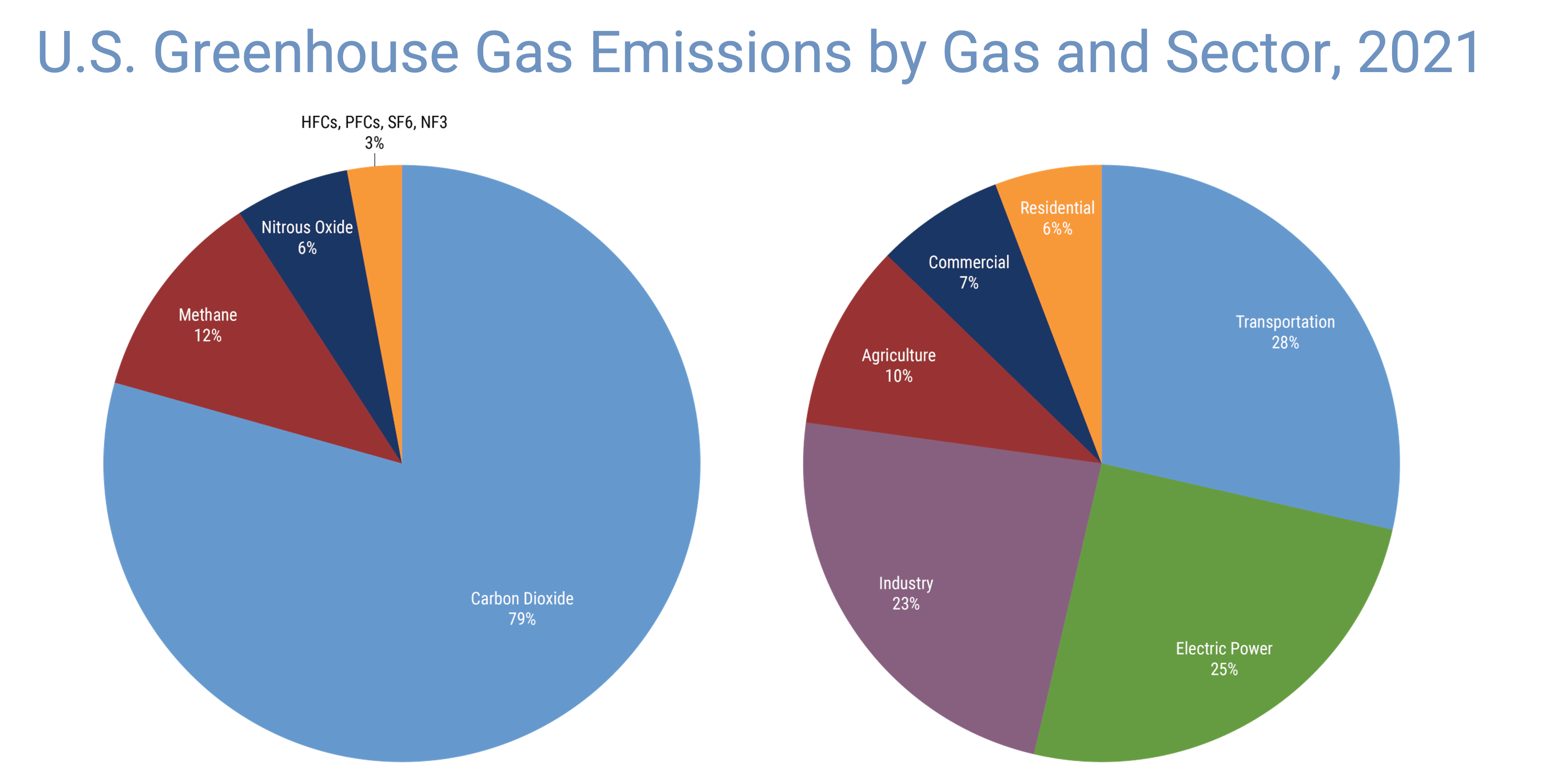
The EcoTech Synthesis seeks to achieve “net zero” by 2050 by substituting “CleanTech” for “DirtyTech.” What’s the difference between them? Well, DirtyTech generates greenhouse gas emissions (GHGs) and CleanTech does not. The pie chart on the left identifies the major GHGs. The pie chart on the right are the major sectors of human activity that generate GHGs:
Here are some exmples of CleanTech and DirtyTech:

DirtyTech is usually cheaper than CleanTech; so, people currently use mostly the DirtyTech solutions. The “Green Premium” is the cost of the CleanTech solution less the cost of the DirtyTech alternative for the same result. Example: If jet fuel (DirtyTech) is $2.00/gallon and sustainable aviation fuel (CleanTech) is $3.00/gallon, the Green Premium is $1.00 per gallon or 50% higher.
Because energy is a commodity, most buyers will buy the cheaper alternative. Therefore, the transition from DirtyTech to CleanTech will only occur quickly if and when the “Green Premium” reaches zero or less.
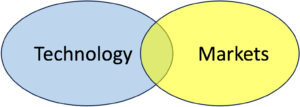
There are two general strategies for driving the Green Premium to zero:
b) increase the cost of DirtyTech.
 Learning Curves
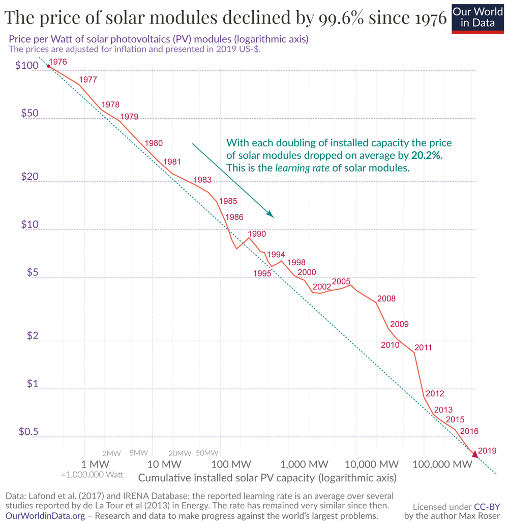
The cost of CleanTech decreases by harnessing discoveries, innovations, experience and economies of scale. I’ll refer to all these sources of improved price/performance, including economies of scale, as the “learning curve.”
A good example of a learning curve is shown in the decreasing unit costs of energy from solar panels:
similar geometric rates of improved cost-effectiveness.
 What drives learning curves?
Answer: Money, primarily. That’s actually a bit glib. Learning occurs over time when the cumulative volume of production grows; every time the cumulative production doubles, the unit cost of the product or service drops by about 20% — some technologies are more, some are less. The volume of production increases when the demand for products or services rises. And it takes money to produce and distribute the products or services.
The money comes a) from investment in innovation, production or growth, and/or b) from revenues generated after the technology is productized and sold to customers. Here are some examples: (Green text is basically “money from investment,” and red text is basically “money from revenues.”)
- Discovery follows from funded science and the scientists who can afford the years of work required.
- Inventions are patented by people seeking fame and/or fortune.
- Governments fund basic research for various reasons — national security, economic development, general welfare, geopolitical leadership, etc.
- Entrepreneurs start out with investments from “friends and family.”
- Philanthropists may back promising developments or “proof of concept” pilots.
- Venture capitalists invest in risky new ventures, seeking outsized returns from the winners.
- “Early Adopters” or market segments with specialized needs buy the CleanTech products when the Green Premium is still pretty large.
- As the learning curve reduces the cost of the CleanTech alternative, the market enters into a virtuous circle: lower costs lead to more sales which lead to even lower costs, etc.
- As this virtuous circle unfolds, later-stage financing sources – private equity, project finance, joint ventures, and others – help fund infrastructure expansion and growth.
The Bottom Line: Money is the mother’s milk of the learning curve. Some of the money comes from investment. Most of the money, however, comes from revenues or investments that rely on revenue, as early versions of CleanTech products or services gain market traction.
How does CleanTech “gain market traction” when its Green Premium is still large?
Take a look at the cost and volume of solar panels in the chart above between 2000 (1.0 gigawatt of capacity deployed at $5.00/watt) and the year 2010 (15 gigawatts of capacity deployed at $2.00/watt). Now imagine you are the salesman for the company selling these solar panels. In 2000, how do you sell something at $5/watt when a diesel generator or gas turbine is less than $1.00/watt? Yes, your solar panels will be below $0.60/watt in 2015, but in 2000, you had to sell them for $5.00/watt.
It’s a chicken-and-egg situation — the more panels you sell, that is, the more the learning curve kicks in, the lower the price gets. The lower the price gets, the more you can sell. But who is the buyer when the price is still relatively high?
While the sales and marketing people are figuring that out, the Chief Financial Officer is trying to keep the lights on. How does s/he raise money from investors and/or use money from early customers to survive? This is the infamous Valley of Death financing gap, and virtually every new technology that disrupts an old market must “get across the Valley of Death” to become self-sustaining and commercially viable.
The Valley of Death financing gap
Whole books have been written on how to navigate The Valley of Death, and we’ll cover it in separate posts. For now, suffice it to say that you either 1) find the “niche markets” willing to pay the higher price or 2) show investors that you can reach the lower costs quickly enough that investors will subsidize the early sales.
Let’s use our solar panel case study and apply it to a niche market: perhaps remote cabins that are not near conventional power lines will buy solar panels at $5.00/watt. Why? Because they don’t have a good alternative. Or they will buy at the premium price because the new technology has a feature (e.g., quiet, clean operation) that’s better than that found in the alternative (e.g., a noisy, sooty diesel generator that requires frequent, inconvenient fuel deliveries, which may need to be hand-carried to the cabin). Another niche market for a new technology: Nuclear submarines that want to stay submerged for weeks at a time. Conventional diesel generators simply can’t meet that need. Did Admiral Rickover care that nuclear reactors cost over $10,000 per megawatt-hour when diesel generators were $100 per mwh? No. Staying submerged for more than 4 hours was worth it.
* * * * * * *
Some key truths:
- Globally, DirtyTech accounts for trillions of dollars in annual economic activity and relies on tens of trillions of dollars of existing capital infrastructure.
- The bulk of all that activity is paid for by consumers and businesses – the private market.
- The scale and speed of the required transition from DirtyTech to CleanTech is so large that no government can afford to fund it. Consider, for example, that the Inflation Reduction Act of 2022 — the largest government investment in climate history. It allocated about $560 billion over 10 years, or about $56 billion per year. That is far less than 1% of today’s annual spending on DirtyTech!
Therefore, the CleanTech transition will be grounded in private market success. And that will be driven primarily by reductions in the Green Premium.
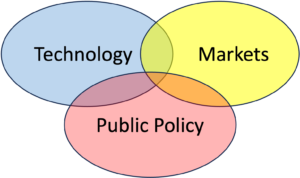
This is where government policies become very relevant. “Public policy” is critically important for driving the discovery, volume and experience components of the learning curve. For example:
- Research and Development. The government provides funding for basic scientific research because such research is too risky or too far from market success to attract private investors. Examples include fusion research at the National Laboratories or grants to universities conducting basic research to improve battery energy density.
- Mandates. The government can require certain groups to purchase CleanTech alternatives, even when the Green Premium remains positive, e.g., renewable portfolio standards imposed on utilities that require them to generate X% of their power using CleanTech by Y date.
- Subsidies. Subsidies, including targeted tax breaks, can reduce the cost of CleanTech alternatives, either by directly subsidizing a buyer (e.g., EVs, heat pumps or solar panels) or by indirectly reducing the cost of supply (e.g., by a low-interest loan guarantee for new capital equipment or factories to produce the CleanTech solution).
- Government Purchasing. Government purchasing can choose a CleanTech alternative, even when the Green Premium remains positive, e.g., when the Department of Defense purchases advanced nuclear technology for submarines or the USPS buys EV postal delivery trucks.
- Standards. Setting or facilitating the setting of standards helps reduce costs or complexity by creating safe, universal and interoperable technology with defined quality and risk levels, e.g., those promulgated by NIST, ANSI, and ANSI-accredited Standards Development Organizations (SDOs). Standards reduce costs and stimulate competition, which in turn further reduces the costs paid by end-users.
- Infrastructure Support. Government spending can cover or reduce the cost of complementary technologies (e.g., charging stations for EVs, which the Bipartisan Infrastructure Act of 2021 funded).
Those are examples of ways that public policy can foster learning curves and reduce the costs for CleanTech.
The government can also adopt public policies that increase the costs of DirtyTech:
- Stop subsidizing fossil fuels:
- Tax Breaks (e.g., oil depletion allowance)
- Below-market Lease and Royalty Rates
- Fossil Fuel Research and Development
- Impose carbon pricing.
The best way to incentivize the transition to CleanTech is to impose a gradually increasing carbon fee at the source (mine, well, pipeline or port-of-entry), coupled with a carbon cashback (aka carbon dividend) and carbon border adjustment mechanism. At Citizens’ Climate Lobby, we strongly advocate for a carbon-fee-and-dividend policy similar to the Energy Innovation and Carbon Dividend Act. - Other public policy tools:
- Prohibitions – e.g., no incandescent light bulb sales, no gas appliances in newly built houses.
- Special fees and taxes – e.g., waste disposal fees on oil from Jiffy-Lube-type businesses; higher license fees on heavier trucks (or exemptions for EV trucks)
- Regulations – e.g., CAFE standards (minimum miles per gallon of gas for vehicles sold). That creates a sales incentive for a salesperson to encourage an EV purchase, thereby improving that statistic for the dealership.
Summary
Our societal goal of achieving net zero by 2050 will require us to replace DirtyTech with CleanTech. We can achieve this by advocating for public policies that leverage the dynamics of the EcoTech Synthesis, whereby learning curves drive down CleanTech costs, preferably to levels where the Green Premium is zero or less. In parallel, we can institute carbon pricing, preferably in the form of a carbon-fee-and-dividend policy, to drive the cost of DirtyTech higher — which also reduces the Green Premium to zero or negative.
In addition to our primary goal of getting to net zero ASAP, Citizens’ Climate Lobby has other goals, values and constraints that inform our actions. Those additional considerations are best summarized in our three acceptance criteria. To pass muster for CCL support, a public policy must be:
- Effective (in reducing GHGs). This embraces our commitment to science-based policies that work and non-partisan legislation, which is likely to be durable over the decades-long timeframes required.
- Efficient (imposing the least cost for the transition). This informs our commitment to using government resources efficiently and advocating for carbon pricing, which all major economists say is the most economically efficient way to drive the transition.
- Equitable (fair). This informs our commitment to environmental justice and strong support for carbon cashback in the carbon-fee-and-dividend program, as well as a carbon border adjustment to create a “level playing field” internationally for US manufacturers.
I believe that the EcoTech Synthesis and public policies that reduce the Green Premium are a suitable scope for what is addressed on this site and in the related newsletter. We will highlight new CleanTech alternatives and their current learning curves that drive the Green Premium lower. When possible, we’ll highlight actions that can increase costs for DirtyTech through reductions in fossil fuel subsidies and/or the implementation of carbon fee-and-dividend policies.
When appropriate, I will try to make clear which part of a post addresses the EcoTech Synthesis by adding an “EcoTech Note” at the beginning of the post. See, for example, the EcoTech Note at the top of US Snowboard Champ Pitches Green Shipping for Maersk.