

Research: Property Prices Imperiled $1.5 Trillion by Climate Change
from 1st Street, published as Climate Driven Population Shifts and Insurance Increases are set to Erase $1.4 Trillion in American Real Estate Value
February 3, 2025
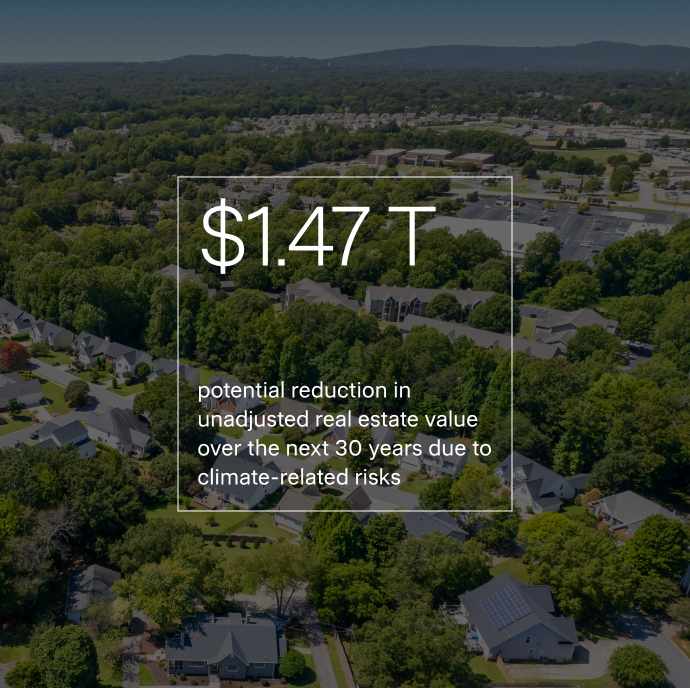
New York (NY) – (February 3rd, 2025) – A comprehensive analysis by First Street, published today in its 12th National Report, Property Prices in Peril, provides critical insights into the observed and projected effects of climate change on the U.S. real estate market. Utilizing new peer-reviewed methodologies1 and macroeconomic modeling, the report estimates a potential $1.47 trillion reduction in unadjusted real estate value over the next 30 years due to climate-related risks.
Drawing on interdisciplinary research that examines climate risk awareness, housing market dynamics, climate migration patterns, and demographic and socioeconomic shifts, the study offers a forward-looking analysis of the Housing Price Index (HPI), property valuation trends, and localized Gross Domestic Product (GDP) impacts extending to 2055.
Key findings indicate that by 2055, climate-driven weather phenomena are expected to increase homeowners insurance premiums nationwide by an average of 29.4%. States like Texas, California, and Florida are projected to experience the steepest increases. Simultaneously, migration induced by climate risks such as extreme heat, wildfire smoke, and flooding is anticipated to drive significant population redistribution, with 55 million Americans expected to relocate within the U.S. over the same period. Regions historically considered less populous, such as North Dakota and Montana, are forecasted to grow due to their climate resilience.
“Climate change is no longer a theoretical concern; it is a measurable force reshaping real estate markets and regional economies across the United States,” said Dr. Jeremy Porter, Head of Climate Implications Research at First Street. “Our findings highlight the urgent need to understand how rising insurance costs and population movements are transforming the economic geography of the nation.”
The study underscores a stark divergence in property values: high-risk areas are likely to experience significant devaluation, while regions perceived as climate-resilient are poised to benefit from increased demand. This reallocation of economic activity has profound implications for local government revenues, with at-risk areas facing reductions in property tax income, while more resilient areas stand to gain.
“These results highlight not only the pressing challenges but also the opportunities for adaptation and innovation in the face of climate change,” added Matthew Eby, Founder and CEO of First Street. “Policymakers, businesses, and communities must act now to mitigate risks and capitalize on the emerging economic opportunities in a shifting landscape.
###
First Street™ is the standard for Climate Risk Financial Modeling working to connect climate change to financial risk. First Street uses transparent, peer-reviewed methodologies to quantify the past, present, and future climate risk for properties globally and makes it available for citizens, industry and government.